Is this 50/30/20 budget template free?
Yes. The Google Sheets copy, the Excel file and the Google Docs guide are free, with no sign-up. You copy the file to your own Google Drive or download it.
Free spreadsheet + Google Docs guide
A free 50/30/20 budget template for Google Sheets, with an Excel download. Enter your monthly take-home income and it splits into three targets: 50% for needs, 30% for wants and 20% for savings and debt.
Some people write the same rule in a different order and look for a 50/20/30 budget spreadsheet. It is the same split, and this template covers both: you can also change the three shares to any numbers that add up to 100%.
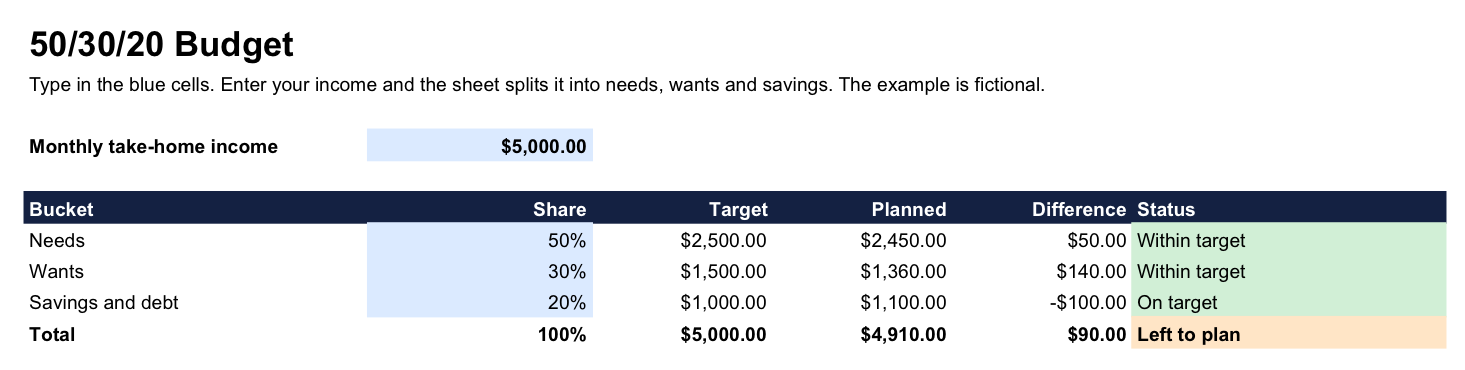
Save a personal copy and check Share settings before entering financial information. Remove the fictional examples before using your own values.
Everything is on one Budget tab. You type in the blue cells; the targets, totals and status are calculated.
The rule divides take-home income, the money that reaches your account after tax, into three parts.
Use the copy button on this page. Google asks you to confirm, then saves a private copy to your Drive. Nothing you type is shared with Fillfolio.
On the Budget tab, type your monthly take-home income. The three targets appear straight away.
Replace the fictional example lines with your own. Pick Needs, Wants or Savings and debt for each, and type the amount you plan to spend or save.
Needs and wants show Within target when you plan the target or less. Savings and debt shows On target when you plan the target or more.
The Total row shows income that is not planned yet. Add it to a line, such as savings, until nothing is left to plan.
50/30/20 is a rule of thumb. Where housing is expensive, needs can take more than half of income. Type your own shares, such as 60/20/20, and the targets update. The sheet warns you if the three shares do not add up to 100%.
| Bucket | Target | Planned | Status |
|---|---|---|---|
| Needs (50%) | $2,500 | $2,450 | Within target |
| Wants (30%) | $1,500 | $1,360 | Within target |
| Savings and debt (20%) | $1,000 | $1,100 | On target |
| Total | $5,000 | $4,910 | $90 left to plan |
Fictional numbers. The plan saves $100 more than the 20% target, and $90 of income is still unplanned.
The Excel download is the same workbook saved as an .xlsx file, with the same formulas, color rules and fictional example. It has no macros. It needs Excel 2019 or later, or Microsoft 365, and also opens in other spreadsheet apps that read .xlsx files.
Yes. The Google Sheets copy, the Excel file and the Google Docs guide are free, with no sign-up. You copy the file to your own Google Drive or download it.
Yes. 50/20/30 lists savings before wants, but the split is the same: 50% needs, 30% wants and 20% savings and debt. This template works for both.
After tax. Use your take-home pay, the amount that reaches your account.
Minimum payments are needs, because you must make them. Anything you pay above the minimum goes in savings and debt.
The bucket shows Over target. You can look for costs to lower, or change the shares to fit your situation, such as 60/20/20.
No. This template plans the month. To log purchases against each category, use the zero-based budget or the monthly budget template linked below.
The template uses fictional example data. Fillfolio is tracking software and does not provide financial, tax or legal advice.